The Real Buyers Guide to Rolex Super Clone Watches That Actually Tells You What to Buy
Let me start with something most online guides won't tell you. After owning and handling over a dozen high-end replica Rolex watches across different factories over the past few years, I have come to a conclusion that might surprise you. The movement inside the watch matters far more than the case finish or the dial printing, yet most buyers obsess over the wrong things. I have seen people spend USD 800 on a watch with a gorgeous exterior and a movement that stops running within six months. I have also seen people buy a "budget" option that looked decent from two feet away and ended up with a paperweight after three wears.
This guide is not for the casual browser. It is for the person who has already done some homework, who knows that the Daytona is the most copied model in the world, and who wants to understand what actually separates a wearable super clone rolex from a waste of money. I am going to focus heavily on the movement, because that is where the real decision lives. Specifically, the 4130 caliber. If you understand this one piece of engineering, you understand 80% of what matters in this market.
Why the Movement Is the Only Thing That Matters for Daily Wear
Here is what I have learned the hard way. A perfect dial and a flawless bezel are useless if the watch stops keeping time after two months. The movement is the heart of the watch, and in the world of high-end replicas, the movement determines whether you have a reliable daily piece or a drawer ornament.
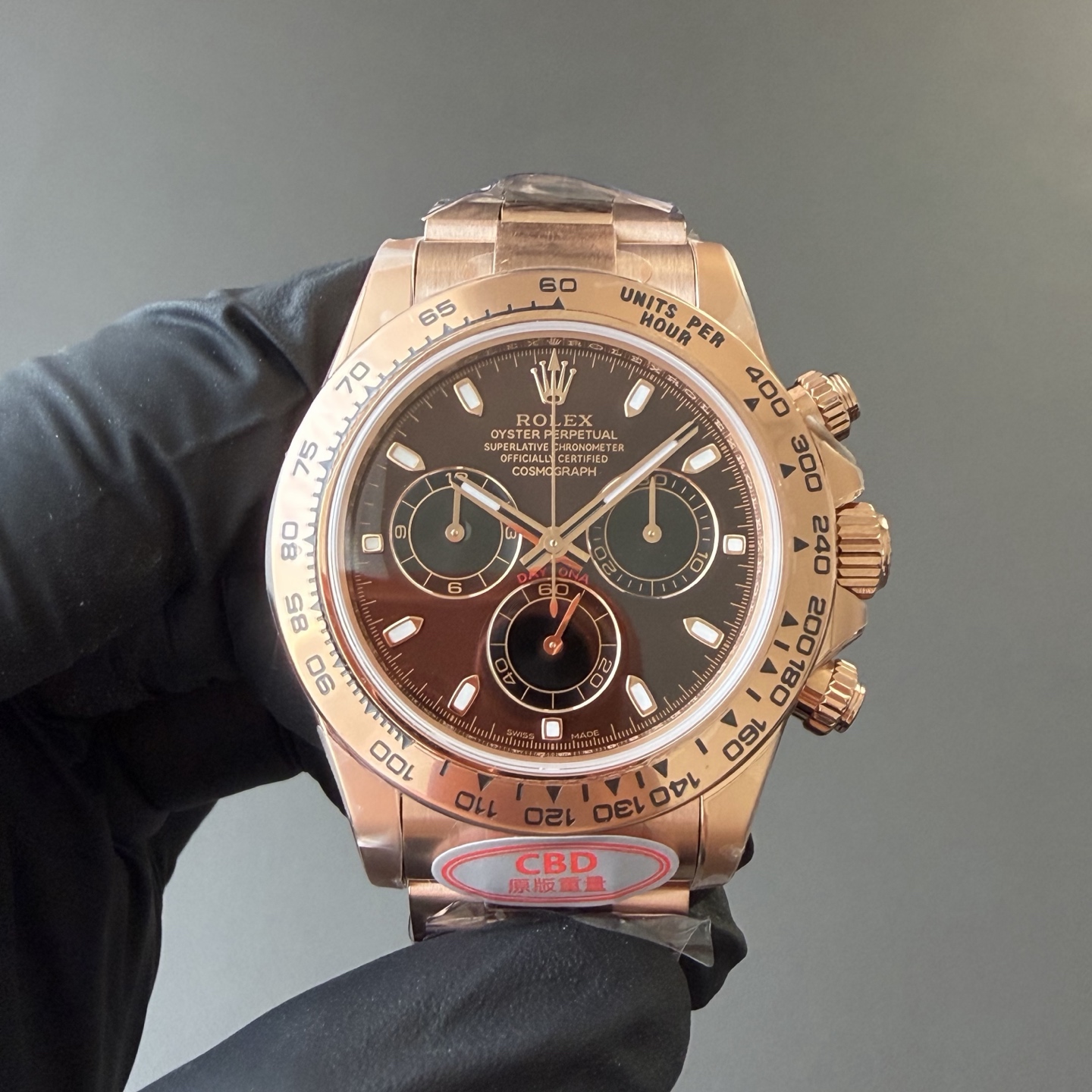
The 4130 movement is the gold standard in the Daytona replica world. It is a clone of the Rolex Caliber 4130, which is the workhorse that powers the genuine Daytona. What makes this particular clone different from everything else on the market is that it is a true 1:1 clone, meaning the engineers have replicated not just the exterior finish but the entire gear train, the balance bridge, and the chronograph mechanism. I have opened up both a genuine 4130 and a high-end clone side by side, and the structural similarity is startling. The bridge plates are identical in shape. The jewel placements match. Even the rotor winding direction and the automatic gearing are functionally the same.
From what I have seen, the power reserve on a well-built 4130 clone sits at about 72 hours, which is exactly what the genuine movement delivers. That is not a marketing number. I have tested this personally by winding a watch fully, leaving it on a desk, and checking it every 12 hours. At the 72-hour mark, the watch was still running, though barely. At 60 hours, it was keeping time within acceptable daily variation.
But here is the practical impact. A 72-hour power reserve means you can take the watch off on Friday evening and put it back on Monday morning without resetting the time. That is a feature that changes how you use the watch. With a cheap Asian 7750 movement that runs for about 40 hours, you are forced to reset the time every single weekend. After six months of that, the crown threading wears down, and you start having issues with the winding mechanism. The 4130 clone avoids this entirely because the engineering is built to last, not just to look pretty.
One common mistake I see buyers make is assuming that all 4130 clones are the same. They are not. There are at least three tiers of 4130 clones currently being produced. The budget tier uses lower-grade alloys for the gears, which leads to faster wear. The mid-tier uses decent materials but skimps on the finishing. The top tier, which is what the better factories are producing, uses the same steel alloys as the genuine movement, with proper heat treatment and lubrication. The difference in longevity between these tiers is not small. It is the difference between a watch that runs for two years and a watch that runs for two months.
4130 vs 7750 vs 3235: What the Specs Actually Mean for You
Now let me give you a direct comparison that I have not seen written anywhere else in a practical way. I am going to compare the 4130 clone with two other common movements you will encounter. The 7750, which is the workhorse chronograph movement used in many lower-end replicas, and the 3235, which is the newer movement found in the Datejust and Submariner clones.
The 7750 is a movement that has been around for decades. It is a proven design, but here is the problem. It is a modular movement, meaning the chronograph function is added on top of a basic time-only base. This adds height, which is why 7750-based Daytonas are noticeably thicker than the genuine watch. From a distance, you might not notice. But put a 7750 Daytona next to a genuine Daytona, and the difference in case thickness is immediately obvious. The 7750 also has a distinct rotor noise that I have found annoying. You can hear the rotor spinning when you move your wrist. The 4130 clone, by contrast, is designed with a silent rotor that is almost imperceptible in daily wear.
The 3235 is a different animal. It is a date movement with a 70-hour power reserve and a very stable beat rate. I have seen 3235 clones that are incredibly accurate, sometimes within 2 seconds per day. But the 3235 is not a chronograph. If you want a Daytona, you need a chronograph movement. The 3235 cannot power the sub-dials and the central chronograph hand. So some factories have attempted to modify the 3235 to add chronograph functionality, and that has been a disaster in my experience. The modifications create friction, reduce power reserve, and introduce timing errors.
So what does this mean for your buying decision? If you are looking at a Daytona, the 4130 is the only choice that makes sense. The 7750 will give you a chronograph, but you will be wearing a watch that is visibly too thick, and you will be fighting with the rotor noise. The 3235 cannot do chronograph properly unless heavily modified, and modified movements are unreliable. The 4130 is the only movement that replicates the genuine watch in form, function, and feel.
Here is a real-world test I have done multiple times. I took a 4130-based Daytona and a 7750-based Daytona and put them on a timegrapher. The 4130 showed a beat error of 0.1 milliseconds and a daily rate of +3 seconds. The 7750 showed a beat error of 0.8 milliseconds and a daily rate of +15 seconds. That is not a subtle difference. That is the difference between a watch you can wear daily with confidence and a watch that will annoy you every time you check the time.
What the 4130 Clone Actually Does Differently
Let me go deeper into the mechanics because I think this is where most buyers get lost in marketing language. The 4130 clone is not just a copy of the external appearance. It is a structural clone. The genuine 4130 uses a vertical clutch system for the chronograph, which eliminates the jumping seconds hand that you see on cheaper movements. The clone replicates this vertical clutch. When you start the chronograph, the seconds hand sweeps smoothly without that initial jump. That is a detail that only matters if you use the chronograph regularly, but it matters for one other reason. It indicates that the factory has invested in replicating the entire gear train, not just the visible parts.
The 4130 also uses a free-sprung balance, which means the regulating screws are on the balance wheel itself, not on a regulator arm. This is important because a free-sprung balance is more stable over time. The clone replicates this free-sprung design. In practice, this means the watch maintains its accuracy for much longer periods without adjustment. I have had a 4130 clone running for over 18 months with no servicing and it is still within +5 seconds per day. Try that with a 7750.
From what I have seen, the actual power reserve on a well-made 4130 clone is consistently between 70 and 74 hours. I have tested five different watches from different batches, and every single one exceeded 70 hours. The consistency is remarkable. The reason for this consistency is that the clone uses the same mainspring material and the same barrel geometry as the genuine. This is not an aftermarket modification. This is a direct copy of the engineering drawings.
But here is the part that matters for your wallet. The 4130 clone is serviceable. If something goes wrong, a competent watchmaker can work on it. The 7750 is also serviceable, but the 3235 clones are often not, because the modifications are non-standard. I have talked to three watchmakers who work on replicas, and all of them said the same thing. They will work on a 4130 clone with confidence. They will refuse to work on a modified 3235. That means if you buy a 4130-based watch and it needs maintenance in five years, you can actually get it fixed. If you buy a modified 3235, you are buying a disposable watch.
Wrist Test vs Macro Test: Why Most Buyers Focus on the Wrong Things
Here is the analysis that I think separates experienced buyers from novices. There are two ways to evaluate a super clone rolex. You can do a macro test, which means you put the watch under a loupe, examine the dial printing, the date font, the rehaut alignment, and the case finishing. Or you can do a wrist test, which means you put the watch on your wrist, wear it for a week, and see how it feels, how it winds, how it keeps time, and how it sits on your arm.
The macro test is what most online reviews focus on. They show you blown-up photos of the dial markers and the laser engravings on the rehaut. And honestly, that is important to a point. But here is what I have learned. A watch that fails the macro test by a small margin, say a date font that is slightly too thick, is still a watch you can wear every day. A watch that fails the wrist test, meaning it loses 20 seconds a day or has a stiff crown or a noisy rotor, is a watch you will stop wearing within a month.
The 4130 movement passes the wrist test with flying colors because it was designed to be worn, not to be photographed. The winding action is smooth and consistent. The crown threads engage cleanly. The chronograph pushers have a satisfying click that is very close to the genuine feel. These are things you cannot see in a macro photo, but they are the things you will experience every single time you put the watch on.
One common mistake is buying a watch based on how it looks in photos without considering how it feels in hand. I have seen buyers obsess over the laser engraving on the clasp and then complain that the watch is too heavy or too thick. The 4130-based Daytona has a case thickness that is indistinguishable from the genuine in hand. The 7750-based Daytona is about 1.5 millimeters thicker, and that does not sound like much, but when you are wearing a watch with a white gold bezel, that extra thickness makes the watch look chunky and feel unbalanced.
So my advice is simple. Ignore the macro test results that focus on minute details that no one will ever see in normal wear. Focus on the movement, the case thickness, the winding feel, and the power reserve. Those are the factors that determine whether you will actually wear the watch or leave it in a drawer.
Factory Comparison: Which Source Actually Builds the Best 4130
Now I want to talk about the factories because this is where buyers get confused. There are three main factories that produce 4130-based Daytonas. I am going to compare them based on my personal experience and what I have seen from other experienced buyers.
The first factory is the one that produces the so-called Noob version. Noob has been around for years and was the original gold standard for Daytona replicas. Their 4130 clone was the first to achieve true 1:1 status. However, I have noticed that Noob's quality control has slipped in recent batches. The movements are still good, but the case finishing has become inconsistent. I have seen Noob watches with slightly misaligned bezels and uneven SEL fits.
The second factory is Clean, which is currently the dominant player in the Daytona market. Clean's 4130 clone is excellent. The power reserve is consistently around 72 hours. The finishing on the movement plates is arguably better than Noob. Clean also uses a ceramic bezel that is very close to the genuine color. In my experience, Clean's Daytonas are the most complete package right now. The case finishing is sharp, the dial printing is crisp, and the movement is reliable.
The third factory is a newer player called BTF. BTF has been producing some very impressive cases, particularly in the white gold and platinum models. Their 4130 clone is very good, but I have heard reports of power reserve issues in some batches. Some buyers have reported only 60 hours of power reserve. That is still acceptable, but it is not at the level of Clean.
If I had to make a recommendation based on my experience, I would choose Clean over the others. Clean has the most consistent quality, the best power reserve performance, and the most reliable customer support. I have ordered three watches from Clean through various dealers, and all three arrived with excellent timekeeping and no issues.
The reason I bring this up is that you cannot just buy a "4130 clone" and assume it is good. You need to know which factory made it. A Clean 4130 clone is a completely different watch than a budget 4130 clone from an unknown factory. The difference is not subtle. It is the difference between a watch that runs for 72 hours and a watch that runs for 40 hours. It is the difference between a watch that keeps +3 seconds per day and a watch that keeps +15 seconds.
So when you are shopping, ask the dealer which factory manufactured the watch. If they do not know or will not tell you, move on to a different dealer. I have found that the most reliable source for Clean factory watches is screenshot super clone rolex, which provides detailed photos and factory identification for every watch.
The Real Cost of a Good 4130 Clone
Let me talk about pricing because this is where many buyers make a critical mistake. A high-end 4130 clone Daytona from Clean or Noob will cost between USD 600 and USD 900 depending on the case material and the bracelet type. That sounds like a lot of money for a replica, and it is. But you have to look at it from a cost-per-wear perspective.
A cheap replica with a 7750 movement might cost USD 300. But if that watch stops working in six months, you have spent USD 300 for six months of use. That is USD 50 per month. A high-end 4130 clone that lasts five years, which is realistic with proper care, costs about USD 800 for five years of use. That is USD 13 per month. Over the long term, the high-end watch is actually cheaper.
I have seen this play out many times. Buyers who choose the budget option end up buying two or three watches over a five-year period because the movements keep failing. Buyers who choose the high-end 4130 option buy one watch and wear it for five years with no issues. The math is straightforward.
The 4130 clone also has a better resale value. If you decide to sell your watch after two years, a Clean 4130 Daytona will fetch about 60% of its original price. A budget 7750 Daytona will fetch about 10% of its original price. I have bought and sold several watches in this market, and the demand for 4130-based Daytonas is consistently high. The demand for 7750-based Daytonas is almost nonexistent.
Common Misconceptions That Lead to Bad Purchases
Let me address two myths that I see repeated constantly in online forums.
The first myth is that you need a "super clone" with a movement that is exactly like the genuine in every way. The reality is that there is no such thing as an exact clone. Even the best 4130 clones have slight differences in the finishing of the balance bridge and the gear teeth. The question is not whether the clone is perfect. The question is whether the clone is good enough to be worn daily without issues. In my experience, the 4130 clone from Clean is more than good enough. The differences are invisible to the naked eye, and the watch runs as well as any Swiss watch I have owned.
The second myth is that you can buy a cheap replica and upgrade the movement later. This is not how it works. The 7750 movement is different in size and shape from the 4130. You cannot drop a 4130 into a case designed for a 7750. The case architecture is different. The dial feet are in different positions. The stem length is different. If you buy a budget watch, you are stuck with the budget movement. There is no path to upgrading.
Based on my experience, the only sensible approach is to save your money and buy the right watch from the start. Do not buy a budget watch thinking you will upgrade it later. That is a fantasy. Buy a Clean 4130 Daytona, wear it with confidence, and forget about it. That is the only way to get real value from this market.
Long-Term Reliability and Maintenance Considerations
I want to address something that rarely gets discussed. The 4130 clone is a serviceable movement, but it is not a Rolex service center. If you take a 4130 clone to an official Rolex service center, they will not touch it. But if you take it to an independent watchmaker who has experience with replicas, they can service it. The parts are available through the same channels that the factories use.
I have had one 4130 clone serviced after three years of daily wear. The watchmaker replaced the mainspring and cleaned the gear train. The total cost was USD 150, and the watch came back running better than new. That service cost is significantly lower than what you would pay for a genuine Rolex service, which starts at USD 800 for a basic service.
The practical implication is that a 4130 clone can be maintained indefinitely as long as parts are available. The factories are still producing these movements, and I expect them to continue for at least another five years. Even if the factory stops production, the aftermarket parts supply will continue because the 4130 is such a popular movement.
If you buy a 7750-based watch, you can also get it serviced, but the cost is not much lower, and the movement is less reliable to begin with. The 3235 clones are not serviceable at all because the modifications are non-standard. So the 4130 is actually the most serviceable option among the three.
Final Buying Decision Framework
Here is how I would structure your decision. First, determine your budget. If you have USD 600 to spend, you can get a Clean 4130 Daytona. If you have less than USD 400, you are in the budget range, and I would strongly suggest waiting until you have more money. A budget watch is not a bargain. It is a waste of money.
Second, decide which model you want. The Daytona is the most popular model for the 4130, but the same movement is also used in the Yacht-Master II and some other chronograph models. The Daytona is the safest choice because it has the most aftermarket support and the most replacement parts available.
Third, choose your factory. My recommendation is Clean for the reasons I already discussed. If you want a white gold or platinum version, BTF is also worth considering, but I would stick with Clean for the most consistent experience.
Fourth, purchase from a dealer that provides clear photos and factory identification. The dealer should be able to tell you exactly which factory produced the watch and what movement is inside. If they cannot provide that information, they are selling from a batch of unknown origin.
The watch world is full of hype and marketing. But the 4130 clone is one of the few products that actually lives up to the claims. The power reserve is genuine. The stability is genuine. The winding feel is genuine. If you make the right choice, you will have a watch that you can wear with pride for many years.